Spider Cricket
Adult Female, profile

Spider Cricket
Adult Female, anterior
| Spider Cricket Adult Female, profile | | Spider Cricket Adult Female, anterior | | ||
 | Class: | Animals (Animalia) - Jointed Legs (Arthropoda) - Insects (Insecta) | |||
| Order: | Crickets, Grasshoppers & Katydids (Orthoptera) | ||||
| Family: | Spider Cricket (Grylloidea: Phalangopsidae) iNaturalist Observation | ||||
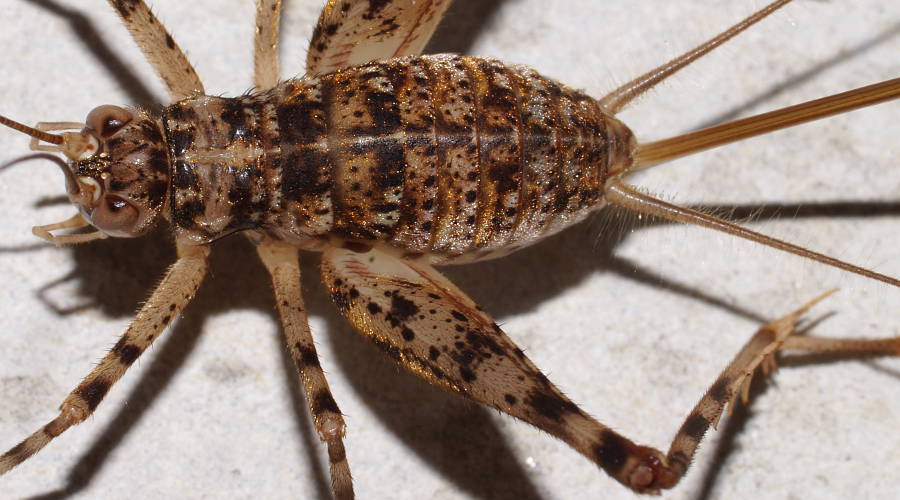
| Species: | Spider Cricket (Endacusta australis) | ||||
| This Photo: | Adult Female, close up | ||||
Thank you Matthew Connors for identifying and Reiner Richter for confirming the id of this species for us General Species Information: Found on Ellura (in the Murray Mallee, SA) and elsewhere Not a lot is known of our Australian crickets. Like so many inverts, genital examination is often required to get below genus level to species. They love our carport, so often see them on the walls. Recently we noticed a couple shedding/moulting, and discovered that they eat their exuviae (disgarded exoskeleton). This is an excellent adaption to save precious resources. They use gravity to "fall" out of their old exoskeleton, but we've rotated a couple of the images to show more detail; as well as leaving one vertically to see the correct orientation. We have made some assumptions here: 1. Female age is based on the length of ovipositor. 2. Females are wingless. 3. Adults males of this genera don't seem to have full length wings. We can't be sure all the specimens here are the same species. But they do look very similar and most were found in the same area. | |||||
| |||||
| |||||